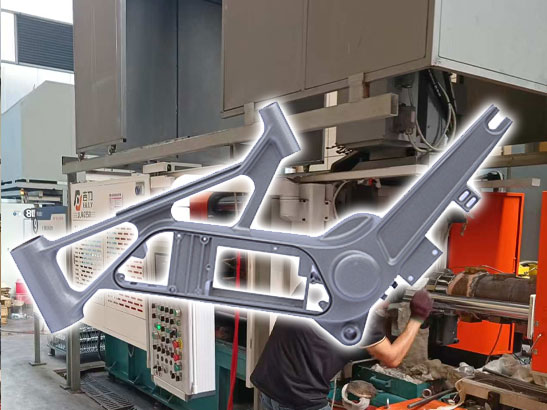
Molten magnesium alloy (approximately 650–700°C) is injected into the cavity of a steel die via a die-casting machine under high pressure (typically 30–100 MPa) and at high speed, rapidly filling the mold and solidifying to form the part. Magnesium high-pressure die casting is currently the most widely used and mature forming process for magnesium alloy components.
Magnesium Die Casting in Innovaw
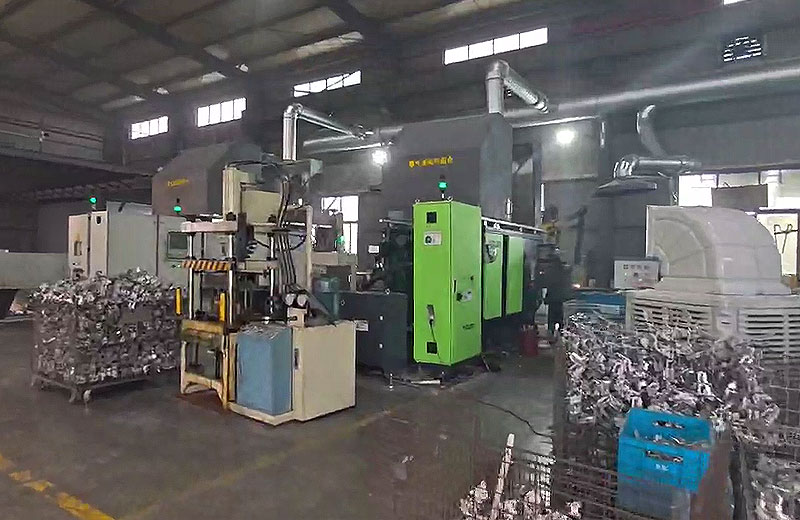
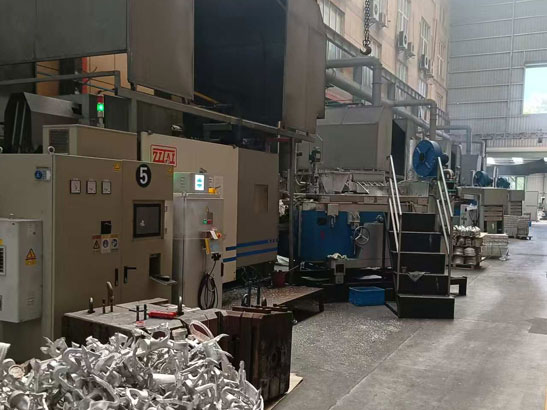
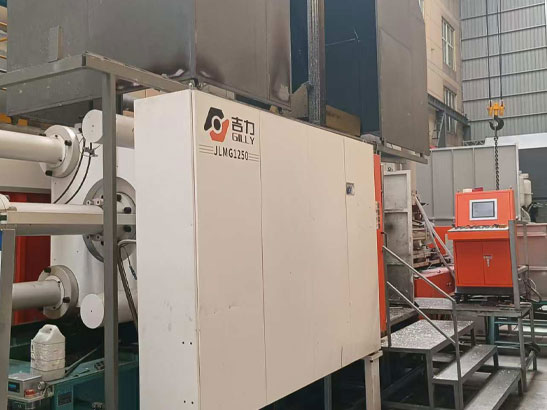
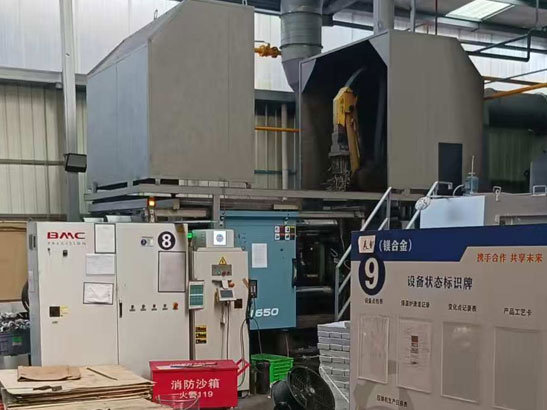
Our high-pressure magnesium die-casting production line consists of six cold-chamber die-casting machines equipped with closed-loop melting and feeding systems. Machine tonnages range from 280 metric tons to 1,000 metric tons. Brands include Yizumi and L.K.
Our magnesium alloy die-cast products cover automotive parts, telecommunications equipment, robots, 3C electronics components, LED lighting components, and sports equipment. Product dimensions range from 10 x 20 mm to 800 x 1,100 mm, and weights range from 10 g to 20 kg.
Material Scope:
Magnesium:
AZ91D, AM60B, AM50A, ZE41A
To better provide customers with one-stop services, Innovaw continues to invest heavily in research and development in the field of magnesium die casting. This includes introducing state-of-the-art high-pressure magnesium die casting equipment and conducting research into magnesium alloy semi-solid forming technology. Through continuous practical application, we are constantly refining the details of our magnesium alloy die casting processes, striving for continuous improvement.
What Is Magnesium Die Casting (MDC)?
Magnesium die casting is a manufacturing process in which molten magnesium alloy is injected under high pressure into a steel mold (die) to produce precise, lightweight metal parts.
1. Key Characteristics
Material: Magnesium alloys (the lightest structural metals)
Process: HPDC allows for short cycle times, often less than a minute, making it ideal for mass production.
Result: The process enables the creation of intricate shapes with tight tolerances and smooth surfaces.
2. Advantages
Extremely lightweight (about 30% lighter than aluminum)
High strength-to-weight ratio
Good dimensional stability
Excellent heat dissipation
Good electromagnetic shielding (EMI/RFI)
3. Typical Applications
Automotive components (steering wheels, brackets)
Electronics housings (laptops, mobile devices)
Aerospace parts
Power tools and handheld devices
In short, magnesium die casting is ideal for producing strong, lightweight, and high-precision parts, especially where weight reduction is critical.
Magnesium Alloy in Component Manufacturing: Lightweighting Trends and Technical Advantages
In industries such as automotive, aerospace, 3C electronics, power tools, and robotics, an increasing number of components are being manufactured using magnesium alloys. The key reason is that, while meeting strength and functional requirements, magnesium alloys offer lighter weight, better vibration damping, and higher machining efficiency.
1. Low density, with outstanding weight-saving advantages
Magnesium has a density of approximately 1.74 g/cm³, which is significantly lower than that of aluminum alloys (approximately 2.7 g/cm³) and far lower than that of steel (approximately 7.85 g/cm³). Therefore, when structural design permits, replacing aluminum alloys with magnesium alloys can further reduce component weight. This is particularly valuable for industries such as automotive weight reduction, electric vehicles, drones, aerospace, robotics, and portable electronic devices.
2.High Specific Strength
Although magnesium alloys are lightweight, this does not imply low strength. Engineers focus more on specific strength (strength-to-weight ratio) and specific stiffness (stiffness-to-weight ratio). By optimizing cross-sections, reinforcing ribs, and wall thickness designs while meeting structural strength requirements, magnesium alloy parts can achieve excellent weight reduction.
3. Excellent Vibration Damping Properties
Magnesium alloys possess good damping capacity, enabling them to absorb and attenuate vibrations—a critical property for automobiles, electric motors, and precision equipment.
4.Good Casting Properties, Suitable for Complex Thin-Walled Parts and Monolithic Structures
Magnesium alloys have relatively good fluidity, allowing for the use of high-pressure die-casting processes to produce complex structures such as thin walls, deep cavities, ribs, porous structures, and complex curved surfaces. As a result, products that previously required multiple assembled parts can now be realized as a single magnesium alloy die-casting, significantly reducing the number of parts and assembly costs.
5. Good machinability
Magnesium alloys typically require low cutting forces, so under appropriate process conditions, they can be machined with high efficiency.
6. Good Electromagnetic Shielding Properties
Magnesium alloys possess good electrical conductivity, enabling them to provide a certain level of electromagnetic interference (EMI) shielding.
Lightweight + High Specific Strength + Excellent Damping + Complex Part Integration: Combining these advantages, magnesium alloys are finding broader application in components where weight, vibration, and structural integration are particularly critical.

.png)


.png)
.png)
.png)

.png)


.png)

.png)

 +86-574-83008051
 sales@innovaw.com
.png)


.png)