Recently, during a routine inspection on one of INNOVAW’s aluminum die casting production lines, an inspector identified a component with a critical dimension that did not meet the requirements specified in the Work Instruction .
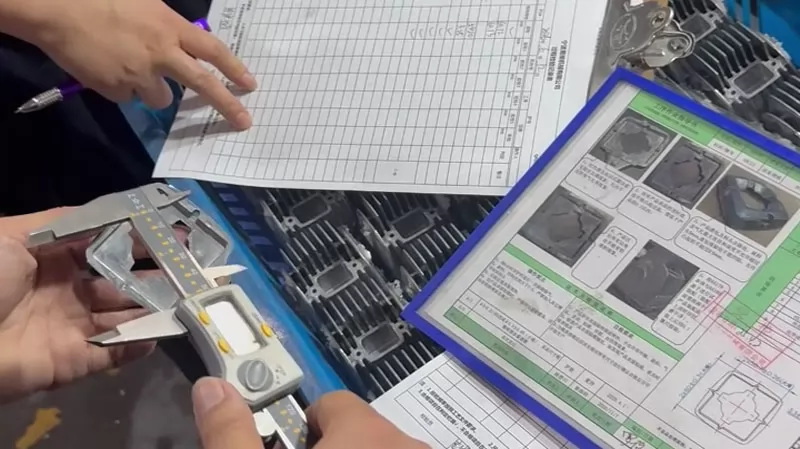
Once the abnormality was identified, the inspector did not simply reject the part and move on. In accordance with our IATF 16949 quality management system, the relevant process was immediately initiated, including nonconforming product control and an MRB (Material Review Board) review.
1. Identifying and Containing the Nonconformity
After detecting the dimensional deviation, the inspector first verified the measurement result and reviewed the relevant drawing, inspection requirements, Work Instruction, and measurement equipment status to rule out measurement error or improper inspection methods.
Once the nonconformity was confirmed, the affected products were immediately identified, segregated, and placed under controlled status to prevent unintended use or further processing.
The team then traced the relevant production batch, machine, tooling, raw material, and production time period to determine the potential scope of the issue.
Where necessary, additional inspection was performed to determine whether other parts from the same production period were potentially affected.
The key questions at this stage were:
When did the problem start?
How many parts could be affected?
Could any nonconforming products have moved to the next process or been shipped to the customer?
This is the first step in effective nonconforming product control.
2. MRB Review — Cross-Functional Problem Solving
After the initial confirmation and containment, the Quality Department organized an MRB review.
Depending on the nature and severity of the issue, the review may involve personnel from Quality, Engineering, Production, and other relevant functions. When necessary, additional departments or customer representatives may also be involved according to applicable requirements.
The purpose of the MRB review is not simply to decide whether the parts should be scrapped.
The team evaluates several key questions.
Is the product actually nonconforming?
The actual measurement data are compared against the applicable engineering drawing, technical specifications, Control Plan, and Work Instruction to clearly define the deviation.
What is the potential scope of the problem?
The team reviews production records and traceability information, including batch information, production time, equipment, tooling, and process conditions, to determine whether similar products may be affected.
What should be done with the nonconforming products?
Based on the actual condition and product requirements, the MRB determines the appropriate disposition, such as:
-Rework
-Repair
-Sorting / 100% inspection
-Scrap
-Other authorized disposition
If a deviation requires concession or customer approval, the applicable authorization process must be followed. Products cannot simply be released by production personnel without proper approval.
3. Going Beyond Product Disposition — Finding the Root Cause
An MRB review should not stop at deciding what to do with the nonconforming parts.
The team must also determine why the dimensional deviation occurred and whether the problem could happen again.
For an aluminum die casting component, potential causes may include:
* Tooling condition or dimensional changes
* Die temperature variation
* Changes in die casting process parameters
* Product deformation
* Downstream machining variation
* Measurement method or fixture condition
* Operator or process variation
Quality, Engineering, and Production personnel work together to analyze process records, machine parameters, tooling conditions, inspection data, and historical quality information.
The objective is to identify the **root cause**, rather than simply treating the symptom.
If the problem is an isolated event, targeted corrective action may be sufficient.
If a systemic risk is identified, the team will further evaluate the relevant process and implement preventive improvements to reduce the possibility of recurrence.
4. Verification and Closure
Once the MRB disposition has been implemented, the process is not considered complete.
For products that have been reworked, repaired, or sorted, the applicable inspection and verification requirements must be completed before the products can be released to the next process.
At the same time, the relevant information—including the MRB decision, product disposition, responsible departments, corrective actions, and verification results—is documented and retained to ensure full traceability.
For recurring or higher-risk problems, additional corrective action and continuous improvement activities may be initiated.
Where necessary, relevant quality documents such as the PFMEA, Control Plan, Work Instructions, and inspection standards are reviewed and updated.

---
One MRB Review Reflects Our Complete Quality Management Approach
At INNOVAW, we believe that IATF 16949 is more than a collection of documents and procedures. It is a systematic approach to managing problems on the production floor.
From the moment an abnormality is detected, through containment, risk assessment, MRB review, root cause analysis, product disposition, corrective action, verification, and continuous improvement, every step is controlled and traceable.
Identify the problem.
Contain the risk.
Trace the affected products.
Find the root cause.
Implement corrective action.
Verify the result.
Prevent recurrence.**
This is how we apply IATF 16949 in our aluminum die casting operations.
We don't simply control nonconforming products. We use every quality issue as an opportunity to make our processes more stable, reliable, and continuously improving.

.png)


.png)
.png)
.png)

.png)


.png)

.png)

 +86-574-83008051
 sales@innovaw.com
.png)





.png)